
Best Ecommerce Site Builders: Find the Right Approach for Your Online Store
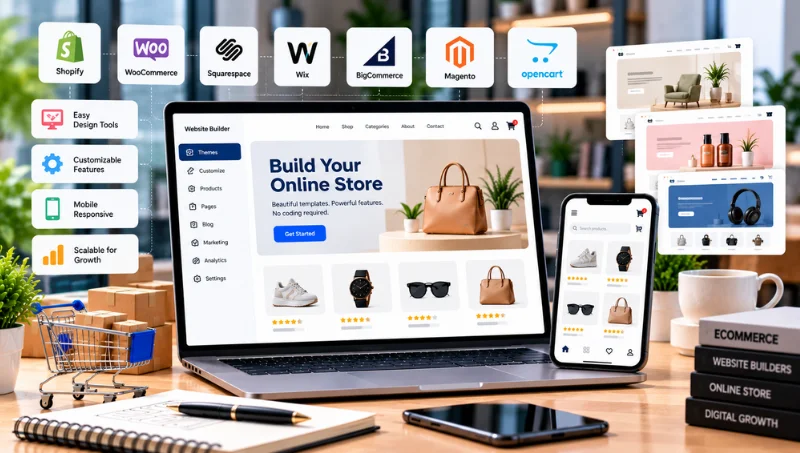
The best ecommerce site builders are not simply the options with the longest feature lists. The right way to build your store depends on what you sell, how your customers shop, and how your team manages products, payments, orders and delivery. EchoPx helps businesses move from a website idea to a custom ecommerce experience built around those real requirements.
Whether you are starting your first online store or reviewing an existing selling process, understanding the difference between a ready-made builder and a custom ecommerce website can help you make a more informed investment. Explore practical selection criteria, essential store features and the questions worth asking before development begins.
EchoPx is a custom ecommerce website design and development company. It does not rank builders and does not offer a public self-service builder product.
Prefer email? Request a Custom Ecommerce Proposal at info@echopx.com.
Get a Free Quote
What Does an Ecommerce Site Builder Actually Do?
An ecommerce site builder is a way of creating an online storefront with tools for presenting products and enabling online purchases. Some approaches offer predefined layouts and configurable functions. Others involve tailored design and development to accommodate particular customer journeys and internal workflows. Neither approach should be judged by appearance alone: the daily tasks behind a store are just as important as the page customers see.
People searching for the best ecommerce website builders are often comparing ease of setup, design freedom, total cost and store functionality. A visually appealing homepage may be useful, but selling also requires accurate product details, workable shopping carts, checkout options, customer accounts, payment handling and delivery information. The right solution should make those connected activities practical for both customers and staff.
EchoPx focuses on custom ecommerce website design and development. Its documented ecommerce capabilities include product catalogue management, customer accounts, shopping cart and wishlist functions, checkout, order management, payment integration support, shipping controls, theme management, content pages and administration. The appropriate feature scope is defined around each business rather than assuming every store needs everything at launch.
Why Choosing a Builder Can Be Difficult
A storefront that looks good but is hard to shop
A customer needs to find the correct product, review its details and move through checkout without unnecessary confusion. Attractive visual themes cannot compensate for poorly structured categories, hard-to-read product information or unclear actions. A buyer evaluating online store builders should test how the storefront works during an actual shopping journey, not just how its homepage appears in a demo. Products sold in multiple sizes, specifications or configurations need pages that explain those choices clearly.
Unclear scope and unexpected complexity
A website-building decision can seem straightforward when the discussion starts with templates and design. Complexity often appears later: product variations, coupon conditions, shipping charges, order status changes or administrative permissions must fit together. Businesses can avoid unnecessary rework by documenting which features are essential at launch, which can be phased in later and which are not required.
Customer and operations experience become disconnected
The storefront and the admin panel are two sides of the same operation. Customers may see products and place orders while employees need to update product details, review payments, track fulfilment and respond to account questions. If those tasks require excessive manual effort, a seemingly convenient builder may not remain convenient over time.
Budget uncertainty and the pressure to choose quickly
A low initial setup cost is only one part of the ecommerce website decision. Store owners should also consider ongoing maintenance, changes to page structure, new requirements, content updates and any separately billed third-party services. Instead of asking only which option is cheapest, ask what is included, which functions are optional and how changes will be handled.
Custom Ecommerce Design Around Your Business
EchoPx approaches online stores as connected shopping and management systems. Rather than using "best ecommerce site builder" as a claim about any one product, the focus is on identifying the combination of interface, catalogue structure and operational functions that suits the business. This includes examining the customer path from discovery to order confirmation and the administrative path from creating products to managing orders.
A custom approach can be relevant when a business needs specific product organisation, tailored visual presentation or workflow choices that are difficult to express through a standard configuration. EchoPx's documented ecommerce functions provide a basis for designing storefront and administrative experiences around these needs. The project discussion determines which functions belong in the final scope.
Businesses searching for a custom ecommerce site builder should distinguish between two meanings: software that allows nontechnical users to assemble pages, and a professional team building a customised online store. EchoPx offers the latter, custom ecommerce website design and development, and does not describe itself as a public self-service builder platform.
How to Compare the Best Ecommerce Site Builders
1. Product catalogue fit
Start with the products, not the visual template. Does the approach represent your categories, attributes, variations, images and bundles clearly? Consider how quickly a team can create a new listing, update a price or adjust a category.
2. Product discovery and detail pages
Review product search, category navigation, listing layouts and individual product pages. Customers should be able to identify the right item and review the information needed for a confident purchase.
3. Cart, wishlist and checkout experience
Evaluate the path from selecting an item to placing an order. A useful cart supports quantity updates, removals and an understandable summary. Checkout should present address selection, payment choices and order confirmation clearly.
4. Customer account management
Think about registration, login, password recovery, profile changes, multiple delivery addresses and order history. These functions affect both repeat shopping and customer-service requests.
5. Payment and fulfilment requirements
Identify the forms of payment the business intends to accept, including online payment integration support and cash on delivery where relevant. Review payment status handling, shipping zones, delivery charge calculation and shipping status information.
6. Store administration
Ask how the team will manage products, categories, customers, orders, reviews, refunds, tickets, themes and site settings. Request a demonstration of common administrative actions, not only front-end screens.
7. Design flexibility and content updates
Consider theme customisation, banner management, homepage sections, colours, fonts and content pages. A business may need to change promotions or product presentation without redesigning every page.
8. Integration and future changes
Document required API connectivity before selecting a development approach. EchoPx's documented capabilities include authentication, product, cart, order and customer APIs, along with mobile app connectivity and Android APK support. Exact integrations are agreed as part of project scope.
9. Total cost of ownership
Compare initial development with recurring services, maintenance and future changes. Ask whether any theme, extension, payment or delivery charges are outside the quote. "Affordable" makes sense only when the scope and ongoing responsibilities are transparent.
10. Long-term operating fit
Consider who will maintain the store, add products, manage orders and approve changes after launch. The right ecommerce website building company should help clarify handover expectations and maintenance scope before the project begins.
Builder-Led Setup Versus Custom Ecommerce Development
A template-led website-building approach may suit businesses with relatively straightforward products and standard operating needs. It may provide a convenient starting structure, but the business should still check how well the chosen configuration supports real customer journeys, products and checkout requirements.
Custom ecommerce development may be a better fit when the store's presentation, catalogue organisation or administrative needs require more tailored decisions. For example, complex product attributes, specific order workflows and connected customer information can benefit from requirements-led design. Custom work does not automatically mean every possible feature is necessary; good scoping helps prevent unnecessary complexity.
The practical question is not "Which builder is universally best?" It is "Which approach handles our essential operations with acceptable flexibility, cost and ongoing effort?" EchoPx can help businesses translate that question into a custom ecommerce website brief and a defined development scope.
Builder-led setup tends to suit
- Straightforward products
- Standard operating needs
- A convenient starting structure
- Teams comfortable assembling pages themselves
Custom development tends to suit
- Complex product attributes
- Specific order workflows
- Tailored storefront presentation
- Connected customer information
Neither column is a recommendation. Check each against your real products, customers and operations.
Ecommerce Website Design and Development Services
Custom ecommerce website design
Create a storefront structure around the way customers browse and evaluate your products. Page hierarchy, banners, product layouts and consistent navigation should support the purchase process rather than distract from it.
Custom ecommerce website development
Bring together customer-facing pages and ecommerce functions in one project scope. The aim is a store that supports products, customers, payments, shipping and orders as coordinated activities.
Product and catalogue management
Support product creation, category structures, attributes, variations, images and bundles. Product search and detail pages help customers discover items while the administration experience supports routine updates.
Shopping cart and wishlist
Enable customers to add products, adjust quantities, remove items, review their cart summary and maintain a wishlist. These functions make the buying process more manageable across shopping sessions.
Checkout and customer accounts
Plan registration and login, account profiles, address selection, coupon and loyalty support, payment selection, order creation and confirmation according to the selected project requirements.
Payment and order management
Connect supported online payments or cash on delivery, track payment status, handle failed payment scenarios and give the store team controls for orders and their status updates.
Shipping and delivery management
Configure shipping zones and delivery-charge calculation, maintain delivery information and support shipping status tracking within the agreed store workflow.
Store administration and theme management
Manage banners, homepage sections, themes, fonts, colours, pages, products, orders, reviews, refund records, tickets and website settings from an administrative interface.
API backend and mobile connectivity
Consider documented authentication, product, cart, order and customer APIs when a project needs connected functionality. Mobile app connectivity and Android APK support are documented capabilities, subject to the agreed implementation.
Our Ecommerce Website Development Process
- 1
Discover business requirements
Discuss the product range, audience, order process, shipping rules, payment preferences, customer accounts and administrative needs. Identify essential functions and list optional functions separately.
- 2
Structure the store experience
Plan categories, product listings, details, navigation and the flow from cart to checkout. Organise content pages and customer account interactions so shoppers can find the information they need.
- 3
Define design and feature scope
Align visual requirements with ecommerce operations. Determine which theme and content controls, checkout capabilities, order functions and integrations belong in the initial build.
- 4
Develop the storefront and administration
Build and configure the agreed features, including catalogue tools, cart behaviour, account flows, checkout functions and administrative controls defined for the project.
- 5
Review shopping and management journeys
Check typical use cases such as locating a product, changing a cart quantity, choosing an address, placing an order and updating an order status. Review product editing and other routine back-office tasks.
- 6
Prepare launch and ongoing updates
Confirm store content, deployment requirements, responsibility for connected services, and agreed maintenance arrangements. Keep a prioritised list of future refinements based on operating needs.
Benefits of Choosing the Right Ecommerce Building Approach
More relevant customer experiences
When layouts and product information reflect buyer questions, visitors can evaluate products with less uncertainty. That can make the store easier to use without promising a particular conversion result.
Clearer operational control
An integrated view of products, customers, orders and delivery data helps administrators understand common tasks and responsibilities.
A scope that reflects business priorities
Requirements-led planning separates must-have features from enhancements, helping businesses decide where development effort should be directed.
Room for planned adjustments
A defined ecommerce foundation makes it easier to assess later changes in catalogue presentation, content management or connectivity. Any new capability should still be evaluated and scoped.
Better-informed budget decisions
Comparing a consistent set of requirements makes it easier to understand the value and limitations of each approach, rather than choosing solely on an advertised price.
Who Can Benefit from Custom Ecommerce Website Development?
Retail businesses can prioritise product images, categories, attributes, wishlists and straightforward checkout. The catalogue can be organised around product families and variations, while account and order history features help shoppers follow previous purchases.
Fashion and lifestyle stores may need multiple product variants and clear product-detail presentation. Businesses selling home goods or electronics may place additional emphasis on detailed specifications, category structure and product search. Each product type creates different information-design decisions.
Wholesale and business-oriented sellers can begin by documenting catalogue structure, customer account needs and their specific ordering process. Requirements that go beyond the standard ecommerce features should be reviewed before being represented as delivered functionality.
Food, personal-care, accessories and other catalogue-based businesses may benefit from product bundles, promotions, delivery information and content updates. No single storefront configuration should be assumed suitable for every industry; the product range and operating model determine the starting point.
How Businesses Search for Ecommerce Site Builders
Buyers describe this need in several ways. Some search for the best ecommerce site builders or the best ecommerce website builders, others for the best ecommerce site builder, an ecommerce site builder or an ecommerce website builder. Some use broader wording such as best website builders for ecommerce or online store builder, and others specifically want a custom ecommerce site builder.
Related wording follows the same pattern: best online store builder, best online store builders, best ecommerce store builder, ecommerce store builder, best ecommerce builders, ecommerce builders, ecommerce site builder software and ecommerce website builder for small business. Others ask for an ecommerce website development company or a custom online store builder when what they really want is a team that builds the store for them.
Each phrase hides the same decision: should the store be assembled with ready-made tools, or designed and developed around the business? This page treats all of them as a request for a buyer's guide. The criteria above apply whichever wording you used, and they apply to any option you are considering, including ours.
EchoPx does not rank builders and does not claim to be the best ecommerce site builder. We are a custom ecommerce website design and development company. If your requirements call for a tailored store rather than a do-it-yourself setup, we can scope that with you.
What Affects Ecommerce Website Development Cost?
Ecommerce website cost is influenced by the number and complexity of pages, catalogue structure, variations, custom design expectations, checkout choices, payment integration, shipping rules, account management, administrative workflows, connectivity and maintenance requirements. The scope of content preparation and the need for additional changes may also influence project planning.
Before requesting a quotation, prepare a simple brief describing your products, approximate catalogue structure, required payment methods, shipping areas, customer-account expectations and any connected systems. Clarify whether your enquiry is for a new store, a redesign or a functional expansion of an existing website.
EchoPx does not publish a fixed price or "lowest-price" package. A project-specific quotation is therefore more useful than assuming a universal cost. Evaluate a proposal by included functionality, exclusions, ongoing responsibilities and the process for requesting additional work.
Questions to Ask Any Builder or Developer
Whichever route you take, put the same questions to every option so the answers can be compared directly.
- Which store functions are included and which are extra?
- How are products, variations and bundles managed day to day?
- Which payment, shipping and order features are available?
- Who maintains the store after launch?
- What recurring charges apply beyond the initial build?
- How are new requirements handled after the scope is agreed?
- Can I see a demonstration of routine admin tasks?
- What happens to my data and content if I change approach later?
Clear written answers matter more than headline prices or feature counts.
Why Choose EchoPx for Custom Ecommerce Development?
EchoPx is a custom ecommerce website design and development company focused on scalable, user-friendly and conversion-focused online stores. The company profile includes 19+ years, 1500+ clients and 1700+ projects. These figures describe the company background; they are not presented as rankings or promises of project results.
The EchoPx approach connects the buyer experience with the practical work of running an ecommerce business. Product management, customer accounts, cart and checkout, payment handling, shipping, orders and administrative controls are treated as related requirements rather than disconnected add-ons.
Businesses looking for the best ecommerce site builders can use EchoPx as a custom-development option when their needs call for a tailored website rather than a do-it-yourself builder. Discussions focus on actual requirements, requested integrations, phased priorities and the desired experience for customers and store administrators.
Find Us in Bangalore, Serving Businesses Across India
EchoPx is based in Rajajinagar, Bangalore, and works with businesses across India through remote consultations and digital collaboration.
Share your products, preferred storefront experience and operating requirements, and EchoPx can discuss a project-specific custom ecommerce scope.
Areas We Are Based Near in Bangalore
Related Pages
Frequently Asked Questions
What are the best ecommerce site builders?
The best ecommerce site builders depend on the business, its catalogue, checkout needs, budget and preferred level of control. Evaluate how each approach handles product discovery, customer accounts, payments, order management and administration before choosing.
How do I choose an ecommerce website builder?
Document your products, variants, shipping rules, payment needs and routine management tasks. Compare each option against this list and check the full cost, maintenance responsibilities and flexibility for planned changes.
What is the difference between a site builder and custom ecommerce development?
A site builder usually provides predefined tools and configurations for creating a store. Custom ecommerce development defines the design and functions around specific requirements. The right approach depends on the complexity and priorities of the business.
Does EchoPx provide a self-service ecommerce site builder?
EchoPx is positioned as a custom ecommerce website design and development company. EchoPx does not offer a publicly available self-service website-builder product.
Can EchoPx create a custom ecommerce website?
Yes. Custom ecommerce website design and development is EchoPx's primary service, with documented features for products, customers, carts, checkout, payments, orders, shipping and administration.
What product management features can an ecommerce website include?
The documented feature set includes products, categories, attributes, variations, images, bundles, reviews, search and product listing and detail pages. Final inclusion depends on the agreed project scope.
Can the store support customer accounts and order history?
EchoPx's documented features include registration and login, OTP verification, password recovery, profiles, multiple shipping addresses and customer order history.
Can an ecommerce store support online payment and cash on delivery?
EchoPx documents online payment integration support and cash-on-delivery support, along with payment-status tracking and failed-payment handling. Specific payment integrations must be defined for the project.
Which shipping functions are available?
Documented functions include shipping zones, delivery-charge calculation, delivery information management and shipping-status tracking.
Does EchoPx support ecommerce APIs?
The documented feature set lists authentication, product, cart, order and customer APIs, with mobile connectivity support. A specific integration requires project-level review.
Can I change homepage sections and store design?
Documented theme-management functions include theme switching and customisation, banner management, homepage sections, and font and colour settings. The extent of customization depends on the agreed design scope.
Is an affordable ecommerce website possible?
Affordability depends on the required features and the total scope of work. Prioritising essential functions first and deferring optional enhancements can help a business plan its budget.
How much does an ecommerce website cost?
EchoPx does not publish a standard price. Cost depends on design, catalogue complexity, integrations, checkout, fulfilment and maintenance scope. Request a project-specific quotation.
Is custom ecommerce development suitable for small businesses?
It can be suitable when a small business needs a tailored selling experience and defined management functions. The decision should be based on requirements and budget, not business size alone.
How do I start a project with EchoPx?
Share your product types, preferred storefront experience, payment and shipping needs, customer account requirements and any integration needs. EchoPx can use that brief to discuss an appropriate custom ecommerce development scope.
Does EchoPx have a physical office I can visit?
EchoPx is based in Rajajinagar, Bangalore. Businesses across India are supported through remote consultations and digital collaboration rather than a local branch network.
Are there other EchoPx pages relevant to choosing an ecommerce approach?
Yes. EchoPx also publishes pages on ecommerce site builders, ecommerce website builders and custom ecommerce website development. See Related Pages above for direct links.
Build an Ecommerce Website Around Your Business
Choose an ecommerce development approach based on the way your business sells, not a generic list of "best" platforms. If your store needs custom product presentation, structured checkout, order management and practical administrative controls, discuss your requirements with EchoPx. Define the customer experience, identify the essential functions and plan a store built around the work it needs to perform.